Tag: YouthGuidance

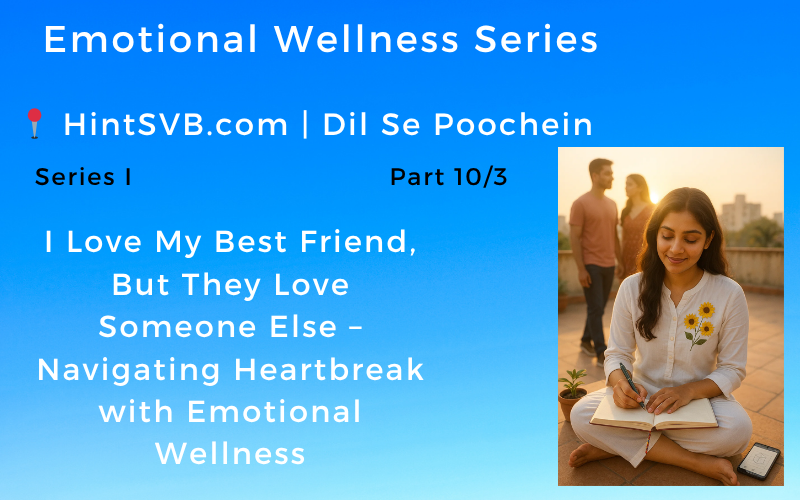
  • Emotional Wellness                  Series  I    Part 10/3

    Emotional Wellness Series  I    Part 10/3

    📍 Hintsvb.com | Dil Se Poochein – Emotional Wellness Series

    ❤️‍🔥 Love & Heartbreak

    I Love My Best Friend, But They Love Someone Else – Navigating Heartbreak with Emotional Wellness

    Introduction

    You’ve memorized their laugh, celebrated their wins, and been their rock through every storm. But now, when they talk about someone else, your stomach drops. How do you love someone who can’t love you back—without losing yourself?

    Emotional Wellness

    Unrequited love for a best friend is a unique emotional wound. It’s not just heartbreak; it’s a collision of deep friendship and romantic longing—two of the most intense human connections—merged into one complicated emotional experience. There may be guilt for having these feelings, shame for holding onto hope, and confusion about whether to stay or step back.

    What makes it even harder is the cultural pressure to either suppress your emotions or stay selfless for the sake of the friendship.

    But true emotional wellness means honouring your feelings without letting them consume you. It means accepting your reality with compassion and choosing healing over fantasy(the imaginary world) .

    In this blog, we’ll explore why loving your best friend can hurt more than a breakup, how to navigate that heartbreak without cutting off the friendship entirely, and how to transform this pain into personal power. You’re not broken—and you don’t have to go through this alone.

    The Emotional Tornado

    Why This Hurts Differently

    emotional wellness

    Unlike a passing crush, this type of love is entangled in emotional history. You already share a bond rooted in trust, care, and closeness. As your feelings shift into romantic territory, the conflict becomes internal: Should you confess and risk the friendship, or stay silent and suffer in hope?

    There’s another layer—the imagined future you’ve quietly built. Losing that future can feel like mourning something that never existed, and yet it still hurts.

    Cognitive dissonance sets in: “I’m happy for them… so why do I feel like I’m falling apart?” Your brain battles between sincere joy for their happiness and the heartbreak of being left out.

    According to fMRI studies, romantic rejection lights up the same brain areas as physical pain. And when rejection comes from someone emotionally close, the brain experiences both social and emotional pain—amplifying the distress.

    emotional wellness
    “The Unspoken Confession”

    This creates a high-stakes scenario: the “double loss”. You might retreat to protect your heart, but that could mean losing the friendship, too.

    To begin healing, you must name what’s happening inside you. Denying it won’t make it disappear.
    Emotional wellness starts with naming the storm inside you.

    The Lies We Feed Ourselves

    ‘I Should Just Get Over It’ and Other Toxic Myths

    Unrequited love often comes with a harsh internal dialogue. You might think:

    • “If I wait long enough, they’ll realize I’m the right one.”
    • “I don’t deserve them anyway.”
    • “I’m being selfish for feeling this way.”

    These thoughts are lies disguised as self-discipline or humility. The first one keeps you in emotional limbo. The second erodes your self-worth. The third prevents you from seeking the support you truly need.

    Here’s the truth: Your feelings are not wrong. They are real, they are valid, and they don’t make you selfish or weak.

    Try this reframe:
    “My love isn’t wrong—it’s energy that needs to be redirected toward healing and self-growth.”

    Unconditional love doesn’t mean unconditional suffering. You can love someone deeply and still recognize when it’s time to refocus that love inward.

    Emotional wellness demands brutal honesty and gentle compassion. It’s not about “getting over it”—it’s about moving through it with clarity.

    The Emotional Wellness Toolkit

    Creating Space Without Ghosting

    You don’t need to completely vanish, but space is necessary for perspective. Try a 60-day emotional reset: pull back from one-on-one meetups, limit vulnerable late-night convos, and skip settings that trigger emotional tension.

    Script suggestion:
    “I care about you and our friendship. Right now, I need a little space to process things. It’s not about ending anything—it’s about giving myself time to recalibrate.”

    Respectful boundaries don’t mean rejection. They create room to breathe.

    Rewiring Your Brain

    Your brain has formed a reward loop—each interaction gives you an emotional high, which can become addictive. Breaking that cycle takes intention.

    When you find yourself fantasizing, replace the thought with three factual reasons why a romantic future may not work.

    Use journal prompts like:

    • What do I truly admire about this person?
    • What might I be projecting onto them?
    • What needs am I hoping they will fulfill?

    Shift your emotional energy into new outlets: start a creative project, plan a trip, or build new friendships.

    When to Seek Help

    Red flags that your mental health may need professional support:

    • Compulsive checking of their social media
    • Interfering with their new relationship
    • Persistent sadness or numbness lasting 6+ months

    Therapy options:

    • CBT to disrupt obsessive thinking
    • Attachment therapy to understand deeper patterns of emotional dependency

    Emotional wellness isn’t something you must navigate alone. Therapy is a tool, not a failure.

    The Phoenix Phase

    How This Pain Can Rebuild You

    Heartbreak, especially from someone close, can destroy illusions—and from that destruction, something new can emerge. This is what psychologists call Post-Traumatic Growth.

    Instead of asking “Why me?”, you begin to ask “What now?”

    What you gain:

    • Stronger emotional boundaries
    • A deeper understanding of your needs
    • Compassion for others experiencing one-sided love

    You may also discover new strengths:
    A person once crushed by heartbreak can become a support system for others. One individual even started a support group that now helps thousands—born out of the very pain they once hid.

    This pain isn’t a dead end—it’s a doorway.

    Emotional wellness isn’t about deleting the past. It’s about transforming it. The same vulnerability that brought pain can lead to power.

    Let this heartbreak make you softer, not smaller.

    Conclusion

    emotional wellness
    The Moving On of the girl now stands confidently in a vibrant mood

    This isn’t the end of love. It’s the beginning of a more honest relationship—with yourself.

    Loving your best friend while watching them love someone else is a uniquely painful experience. But you don’t have to stay stuck in that pain.

    You’re allowed to take space. You’re allowed to be honest. You’re allowed to choose peace, even if it means stepping away.

    Emotional wellness is the courage to look at your truth without shame. It’s giving yourself the care and clarity you so willingly give to others.

    Tonight, text a friend who has loved you unconditionally—no hidden feelings, no complications. Let that remind you what safe, mutual love looks and feels like.

    Bookmark this post for the nights that feel heavy. Let it serve as proof:
    Your heart is not just a waiting room for others.
    It’s a home—and you’re learning to fully live in it.

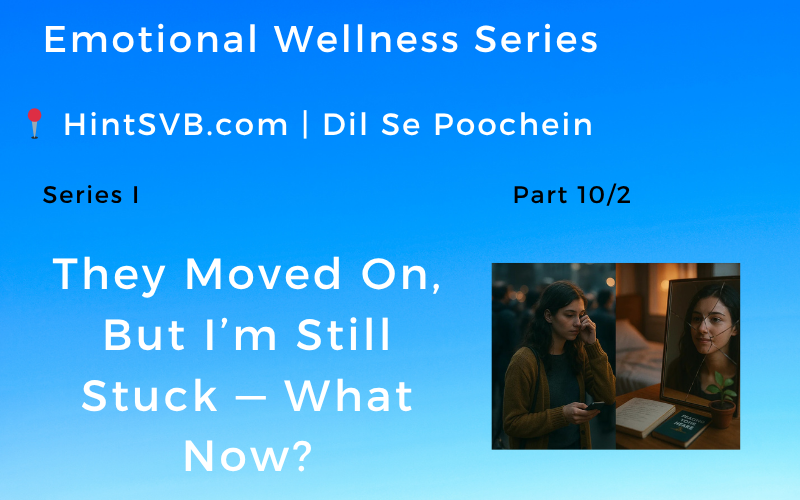
  • Emotional Wellness         Series  I     Part 10/2

    Emotional Wellness Series  I     Part 10/2

    📍 Hintsvb.com | Dil Se Poochein – Emotional Wellness Series

    ❤️‍🔥 Love & Heartbreak

    They Moved On, But I’m Still Stuck — What Now?

    A Journey to Emotional Wellness and Self-Reclamation

    Introduction: The Weight of Watching Them Move On

    It’s been months—maybe years—since they left. You scroll past their social media, and there it is: a new relationship, a smile that no longer includes you. Meanwhile, your heart still flinches. A part of you hoped they’d come back. Another part can’t believe how easily they seemed to move on.

    Heartbreak isn’t just about missing someone. It’s about losing a part of yourself that you built around them. It’s not just the person who left—it’s the routine, the emotional safety net, the identity

    that once felt whole. Now, you’re left questioning everything: Was it ever real? Did I matter? Why can’t I move on?

    Here’s the truth: You’re not broken for feeling stuck. This isn’t about “winning someone back” or rushing to heal. It’s about emotional wellness—the quiet, courageous act of reclaiming your worth and rebuilding from the inside out.

    True emotional wellness begins when we stop measuring our healing against someone else’s timeline.

    Let’s talk about why you feel stuck, what stories might be keeping you there, and how to start moving forward—for real.

    emotional Wellness
    The Girl standing in a crowd but blurred, emphasizing loneliness.

    A phone screen showing a “last message” or a deleted chat.

    Why You’re “Stuck”

    The Science of Heartbreak: Your Brain on Grief

    If heartbreak feels like physical pain, that’s because your brain thinks it is.

    Neuroscience confirms that romantic rejection activates the same brain regions as physical pain—specifically the anterior cingulate cortex and the insula. In other words, the pain you feel isn’t imagined. It’s biological. It’s real.

    So when you see them laughing in a photo with someone else, your brain interprets it as rejection, loss—even danger. It flips into fight-or-flight mode. You freeze. You replay old memories. You analyze messages. You can’t let go—not because you’re weak, but because your brain is holding on to what it once believed was emotional safety.

    The Comparison Trap

    emotional wellness
    The girl wiping tears, looking at a sunrise through a window.

    Watching them move on triggers “social pain”—a deep sense of being replaced, forgotten, or left behind. Their new joy feels like a reflection of your failure. But here’s what matters most: their timeline doesn’t define your worth.

    Your stagnation isn’t a flaw—it’s your mind’s way of asking for deeper healing.

    It’s time to let go of the idea that “time heals all wounds.” Time helps—but only intentional healing transforms pain into growth.

    The Three Stories We Tell Ourselves

    emotional wellness

    “I’ll Never Love Again” and Other Myths That Keep Us Stuck

    Pain tells stories. And heartbreak tells the most convincing ones.

    1. “They were my only chance at happiness.”

    No, they weren’t. They were a chapter—not the whole story. Love isn’t about finding “the one”—it’s about building a life where love can grow and evolve. Believing someone else held your only key to joy limits your future before it’s even begun.

    2. “I deserve this pain.”

    Maybe you’re replaying your mistakes, convinced that this heartbreak is your punishment. But emotional pain isn’t proof of guilt. It’s a signal for healing. You don’t need to earn your suffering.

    3. “I’ll never feel this way again.”

    You won’t—and that’s okay. Because what’s ahead might feel better: more rooted, clearer, more reciprocal. But only if you remain open to it.

    Reframe the Narrative: Ask Better Questions

    Instead of spiralling into absolutes, try curiosity:

    • What if this pain is preparing me for a love I can’t yet imagine?
    • What if letting go is the first real act of self-love I’ve ever practiced?

    Emotional wellness isn’t about blind positivity—it’s about choosing clarity, growth, and grace.

    emotional wellness

    Actionable Healing

    Delete, Don’t Deprive – Why ‘No Contact’ Isn’t Enough

    Many people talk about going “no contact.” But healing goes beyond blocking a number or ignoring texts. It’s about reclaiming your space—both internal and external.

    • Mute triggers. Stop doom-scrolling. Mute social feeds or archive group chats that constantly re-open old wounds.
    • Change your space. Rearranging furniture, buying new bedsheets, or even lighting a new candle can help create emotional distance and fresh energy.
    • Delete old messages or photos. Not to erase the past—but to stop reliving it.

    The 5-Minute Obsession Timer

    When the urge to overthink or cry hits, set a timer. Let yourself feel everything—but only for 5 minutes. Then, move. Stretch. Fold laundry. Take a walk. Call a friend. Let grief come in waves—but don’t let it drown you.

    Reclaiming Who You Were Before “Us”

    You weren’t born into that relationship. You were someone before it. Someone curious, passionate, creative.

    Exercise: Write down 10 passions, hobbies, or dreams that were yours before the relationship.
    Examples:

    • Hiking
    • Painting
    • Reading sci-fi
    • Cooking
    • Playing music
    • Solo travel
    • Writing
    • Volunteering
      Now pick one. Revisit it. Reclaim it—not as a distraction, but as a reminder: You are more than the love you lost.

    Emotional Wellness Reminder: “Joy isn’t a betrayal of your past—it’s an act of rebellion.”

    When to Seek Help (And How to Know)

    Sometimes, heartbreak opens the door to something deeper—like depression or anxiety. And that’s okay.

    If you’ve experienced any of the following for more than three months, consider reaching out to a mental health professional:

    Therapies That Support Emotional Recovery

    • CBT (Cognitive Behavioral Therapy): Helps identify and reframe harmful thought patterns.
    • Grief Counseling: Focuses on processing and releasing deep emotional pain.
    • Support Groups or Circles: Safe spaces—especially those for heartbreak or identity loss—can normalize your experience and reduce isolation.

    Healing isn’t about forgetting. It’s about learning to live, love, and trust again—on your own terms.

    Conclusion: You’re Not Stuck—You’re Becoming

    Here’s what nobody tells you:
    This isn’t a pause—it’s a beginning.

    You are not broken. You are evolving.

    Yes, they moved on. But that doesn’t mean love has left you behind. It means your story is ready for its next chapter—one grounded in self-awareness, purpose, and emotional wellness.

    So take one step:
    Mute the noise.
    Reclaim your joy.
    Reach out if you need help.
    And most importantly—stop waiting for someone to come back to validate your worth.

    You are not the one who got left behind.
    You are the one who chose to rise.

    Jai emotional wellness. Jai you.