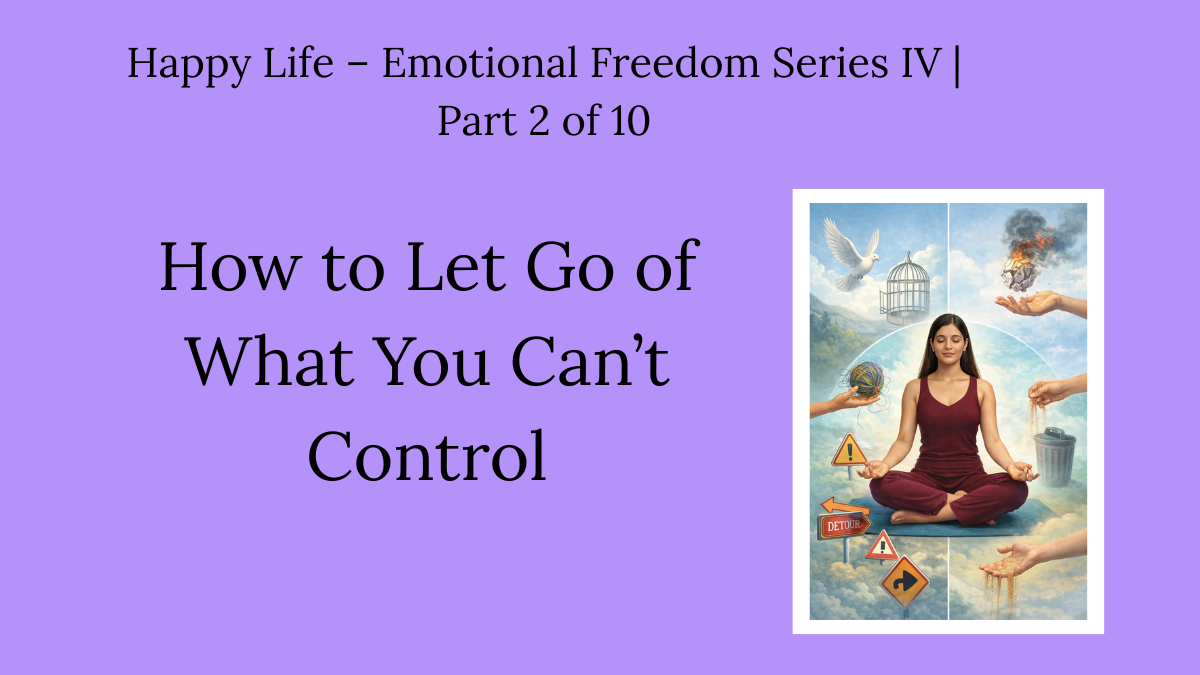
Happy Life – Emotional Freedom Series IV Part 2/10
How to Let Go of What You Can’t Control
(Understanding Emotional Freedom Beyond Resistance)
Introduction: The Illusion of Control
The idea of control is deeply woven into human behaviour. People often believe that control provides safety, certainty, and predictability in an unpredictable world. Learning how to let go of what you can’t control begins with understanding why control feels necessary in the first place. Control gives the impression that outcomes can be managed, emotions can be regulated externally, and uncertainty can be minimized.

However, much of life exists outside personal command. Circumstances change, people act independently, and outcomes unfold according to variables that cannot be directed. The illusion of control persists because it offers temporary reassurance. Emotional freedom is often delayed because energy is spent trying to manage things that are inherently unstable.
When individuals struggle with how to let go of what you can’t control, the challenge is not weakness but misalignment with reality. The need for control often masks discomfort with uncertainty. Letting go emotionally does not remove uncertainty; it changes the relationship with it. Emotional balance begins when control is recognized as limited rather than absolute. This realization forms the foundation of inner peace and acceptance, allowing space for clarity without resistance.
Why Humans Seek Control
Humans seek control because the mind prefers predictability. Stability provides psychological comfort, especially during uncertainty. Understanding how to let go of what you can’t control requires acknowledging that control is a coping mechanism rather than a solution. The desire for control often arises from fear of loss, unpredictability, or emotional discomfort.
From an emotional perspective, control reduces perceived vulnerability. Managing situations, people, or outcomes creates a sense of order. However, this order is often fragile. Emotional freedom becomes constrained when control turns into dependency. Letting go emotionally feels difficult because control has been mistaken for security.
The need to manage things you can’t control—such as other people’s choices, timing, or outcomes—creates internal tension. Acceptance vs control becomes a continuous internal conflict. Emotional detachment does not mean disengagement; it reflects clarity about limits. When control is released, mental clarity increases because emotional energy is no longer tied to unpredictable variables.
Understanding why control is sought allows a calmer approach to how to let go of what you can’t control. It reframes letting go as alignment rather than loss, supporting a more stable happy life mindset.
What “Control” Actually Means
Control is often misunderstood. It is commonly assumed to mean authority over outcomes, people, or circumstances. In reality, control is limited to personal choices, responses, and effort. Learning how to let go of what you can’t control begins with distinguishing influence from control.
Influence exists within action and intention. Control is often assumed over results. This misunderstanding creates emotional strain. Emotional freedom emerges when effort is separated from expectation. Letting go emotionally does not mean abandoning responsibility; it means recognizing where responsibility ends.
Things you can’t control include external behaviour, timing, natural events, and outcomes. Emotional attachment to these variables creates resistance. Releasing emotional attachment does not remove intention; it removes dependency on results. This shift supports emotional balance and mental clarity.
Acceptance vs control is not about surrendering agency. Acceptance acknowledges reality without internal struggle. Control attempts to override reality. Understanding this difference helps clarify how to let go of what you can’t control without disengaging from life. Emotional detachment in this context allows presence without emotional burden, creating space for inner peace and acceptance.
Identifying What Is Truly Uncontrollable
A significant part of learning how to let go of what you can’t control lies in identifying what truly falls outside personal influence. Many emotional struggles arise from misplacing effort toward situations that cannot be directed. These include other people’s decisions, emotional responses, timing, past events, and final outcomes.
Things you can’t control operate independently of intention. Emotional resistance often develops when expectations are placed on these areas. Letting go emotionally begins with recognizing limits rather than forcing resolution. Emotional freedom does not require passivity; it requires discernment.
Mental clarity improves when boundaries between effort and outcome are understood. Releasing emotional attachment to uncontrollable elements reduces internal friction. Emotional balance is restored when responsibility is confined to action rather than results.
Acceptance vs control becomes practical when uncontrollable factors are acknowledged without judgment. This recognition supports a happy life mindset grounded in realism rather than expectation. Understanding how to let go of what you can’t control does not eliminate involvement in life; it reshapes involvement into sustainable engagement.
Emotional Cost of Holding On
Holding on to control carries an emotional cost that often goes unnoticed. Resistance consumes mental energy, creating internal weight. Learning how to let go of what you can’t control involves observing this cost without interpretation. Emotional strain accumulates when effort is repeatedly directed toward uncontrollable outcomes.
Letting go emotionally reduces this internal load. Emotional freedom is not the absence of emotion but the absence of unnecessary resistance. Control-driven attachment binds emotional energy to unstable conditions. Releasing emotional attachment frees attention and restores mental clarity.
The emotional cost of holding on often appears as fatigue, frustration, or persistent mental noise. These states reflect misaligned effort rather than failure. Emotional detachment does not mean indifference; it reflects an adjustment of emotional investment.
Acceptance vs control determines whether emotional energy is conserved or depleted. When control is released, emotional balance improves because attention returns to present reality. Understanding how to let go of what you can’t control shifts emotional weight into emotional stability, supporting inner peace and acceptance without suppression.
Control vs Acceptance

Control and acceptance are often viewed as opposites, but they represent different responses to reality. Control seeks dominance over outcomes. Acceptance recognizes reality as it is. Learning how to let go of what you can’t control requires understanding acceptance without misinterpreting it as defeat.
Acceptance does not remove effort. It removes resistance. Emotional freedom emerges when effort is applied without emotional attachment to results. Letting go emotionally creates space for clarity by removing internal opposition.
Acceptance vs control becomes evident in emotional response patterns. Control creates tension. Acceptance reduces friction. Emotional detachment in acceptance does not eliminate engagement; it eliminates struggle.
Inner peace and acceptance develop when reality is acknowledged without internal negotiation. Releasing emotional attachment does not erase desire; it reframes expectation. Understanding how to let go of what you can’t control allows participation in life without emotional exhaustion, reinforcing a sustainable happy life mindset.
Letting Go as an Internal Shift
Letting go is often misunderstood as withdrawal. In reality, it is an internal shift in perspective. Learning how to let go of what you can’t control involves adjusting emotional positioning rather than external behavior.
Emotional detachment does not mean emotional absence. It reflects clarity about where emotions are invested. Letting go emotionally allows presence without emotional dependency. Emotional freedom grows when internal resistance dissolves.
This internal shift reduces mental noise. Mental clarity emerges because attention is no longer consumed by outcome management. Emotional balance becomes possible when attachment is released without disengagement.
Acceptance vs control within this shift reflects maturity rather than loss. Understanding how to let go of what you can’t control transforms emotional reactions into measured responses. This shift supports inner peace and acceptance while maintaining engagement with life’s realities.
The Role of Expectations
Expectations bind emotional energy to outcomes. When expectations are unmet, emotional discomfort arises. Learning how to let go of what you can’t control requires recognizing how expectations influence emotional states.
Expectations often exist unconsciously. They create internal contracts with reality. Letting go emotionally involves loosening these contracts. Emotional freedom increases when expectations are replaced with awareness.
Releasing emotional attachment to expectations reduces disappointment and frustration. Mental clarity improves as emotional reactions become less dependent on outcomes. Emotional balance develops when effort is valued independently of results.
Acceptance vs control is reflected in expectation management. Control demands fulfillment. Acceptance allows variation. Understanding how to let go of what you can’t control does not eliminate expectation entirely; it prevents expectation from becoming emotional obligation. This distinction supports a happy life mindset grounded in adaptability.
Inner Peace and Emotional Freedom
Inner peace is often misunderstood as emotional numbness. In reality, it reflects emotional alignment. Learning how to let go of what you can’t control creates inner peace by removing resistance rather than emotion.
Emotional freedom arises when emotional responses are no longer dictated by uncontrollable variables. Letting go emotionally restores mental clarity by reducing emotional entanglement.
Inner peace and acceptance coexist with awareness. Emotional detachment allows engagement without emotional overload. Releasing emotional attachment creates space for emotional balance.
Acceptance vs control determines whether peace is conditional or stable. Control ties peace to outcomes. Acceptance allows peace to exist independently. Understanding how to let go of what you can’t control enables emotional freedom that is consistent rather than reactive, supporting a calm and sustainable inner state.
Silence as a Form of Letting Go
Silence is often underestimated. Non-reaction is a powerful expression of emotional detachment. Learning how to let go of what you can’t control includes recognizing silence as an active choice rather than absence.
Silence interrupts reactive patterns. Letting go emotionally through non-response alters emotional dynamics without confrontation. Emotional freedom increases when reactions are no longer automatic.
Mental clarity improves as emotional energy is conserved. Emotional balance is restored when silence replaces resistance. Acceptance vs control becomes visible when silence replaces the urge to correct or manage outcomes.
Understanding how to let go of what you can’t control through silence supports inner peace and acceptance. Silence does not disengage reality; it disengages internal struggle, reinforcing a calm and grounded happy life mindset.
Detachment Without Indifference
Detachment is often confused with indifference. Emotional detachment, however, refers to clarity, not coldness. Learning how to let go of what you can’t control involves remaining present without emotional burden.
Letting go emotionally does not remove care. It removes dependency. Emotional freedom arises when concern exists without attachment to outcomes.
Releasing emotional attachment allows engagement without exhaustion. Mental clarity improves when emotions are no longer driven by uncontrollable variables. Emotional balance is maintained through awareness rather than withdrawal.
Acceptance vs control determines emotional quality. Control creates strain. Detachment creates steadiness. Understanding how to let go of what you can’t control allows participation without emotional depletion, reinforcing inner peace and acceptance.
Releasing Outcomes, Keeping Intent
Intent and outcome are often confused. Intent reflects effort and direction. Outcome reflects variables beyond control. Learning how to let go of what you can’t control involves separating these two.
Releasing emotional attachment to outcomes does not negate intent. It protects emotional balance. Letting go emotionally preserves effort while removing emotional dependency.
Mental clarity increases when effort is valued independently of results. Emotional freedom develops when intent remains active and outcomes are allowed to unfold.
Acceptance vs control becomes practical through this separation. Control demands outcome alignment. Acceptance allows outcome variance. Understanding how to let go of what you can’t control creates a stable happy life mindset grounded in action rather than attachment.
Emotional Balance in Daily Life
Emotional balance is sustained through alignment rather than control. Learning how to let go of what you can’t control reshapes daily emotional responses.
Letting go emotionally reduces reactivity. Emotional detachment allows measured engagement. Mental clarity improves as emotional energy is conserved.
Inner peace and acceptance become consistent when emotional responses are no longer outcome-dependent. Acceptance vs control becomes a daily practice rather than a concept.
Understanding how to let go of what you can’t control supports emotional freedom that is practical and sustainable. Emotional balance emerges not from avoidance, but from clarity.
Conclusion: Freedom Without Control
Freedom does not come from control. It comes from alignment with reality. Learning how to let go of what you can’t control allows emotional freedom without disengagement.
Letting go emotionally creates mental clarity and emotional balance. Inner peace and acceptance emerge when resistance dissolves.
Acceptance vs control defines emotional experience. Control binds peace to outcomes. Acceptance allows peace to exist independently.
Understanding how to let go of what you can’t control supports a happy life mindset grounded in awareness, clarity, and emotional stability. Emotional freedom exists not in dominance over life, but in harmony with its uncertainty.