Tag: empowered women

  • Women Empowerment Series  II      Part 20/5

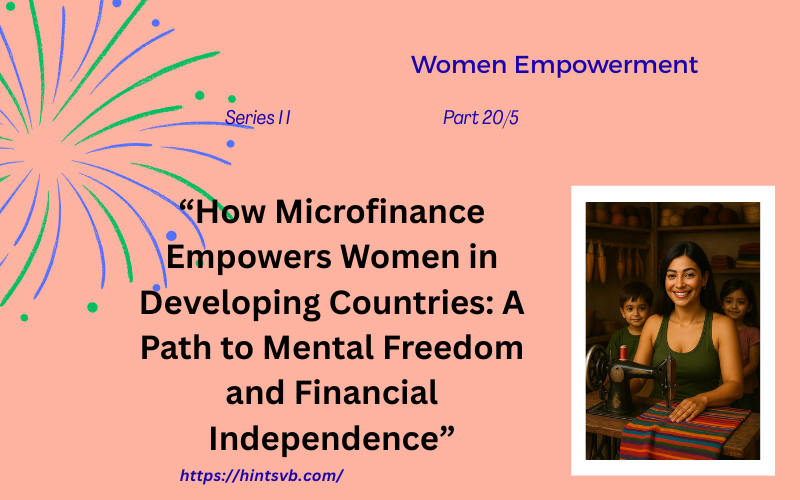
    Women Empowerment Series  II      Part 20/5

    How Microfinance Empowers Women in Developing Countries: A Path to Mental Freedom and Financial Independence

    “Introduction to Microfinance: Meaning, Importance, and Role in Financial Inclusion”

    Microfinance is a powerful tool that provides small loans, savings, and financial services to individuals who are traditionally excluded from the formal banking system. It primarily supports low-income families, women, and small entrepreneurs, helping them break the cycle of poverty and achieve financial independence. Unlike conventional banks that require collateral, microfinance institutions (MFIs) focus on trust, community participation, and repayment through small installments.

    women empowerment

    The concept of microfinance gained global recognition through the efforts of Dr. Muhammad Yunus and the Grameen Bank in Bangladesh. Today, it has expanded worldwide, playing a crucial role in promoting financial inclusion and sustainable development. Microfinance not only offers credit but also encourages savings, micro-insurance, and skill development, empowering people to build small businesses, improve education, and enhance healthcare.

    One of the key benefits of microfinance is women empowerment. By giving women access to financial resources, microfinance helps them contribute to household income, make independent decisions, and uplift their families. Women empowerment also fosters entrepreneurship, enabling women to start small ventures and achieve self-reliance. In rural and urban areas alike, microfinance creates opportunities for women empowerment that strengthen communities. Ultimately, women empowerment through microfinance leads to long-term social and economic transformation.

    “The Role of Microfinance in Women’s Empowerment and Mental Freedom”

    women empowerment

    In a remote village, a Rs. 500 loan didn’t just buy sewing supplies—it bought dignity, voice, and mental freedom for a woman who had never owned anything before. That small amount of money allowed her to start a micro-business, contribute to her household, and, most importantly, feel seen and heard in ways she never had before.

    This is the silent revolution of microfinance. While it might look like just a transaction on paper, for millions of women across developing countries, it represents a doorway to autonomy, self-worth, and resilience. True women empowerment begins when financial access meets self-awareness and opportunity.

    Microfinance—providing small loans and financial services to people traditionally excluded from banking—has become one of the most powerful catalysts for change. It’s not just about lending money; it’s about lending confidence, trust, and a chance to rewrite one’s story.

    The impact goes far beyond financial independence. When women gain the ability to make decisions about money, they also gain a sense of mental clarity and self-determination. Suddenly, how Money Matters become Mind Matters in the journey toward a Happy Life becomes evident.

    This blog explores how microfinance programs empower women not only economically but emotionally, mentally, and socially. From breaking the cycle of poverty to reducing stress and fostering optimism, microfinance has proven to be more than a financial tool—it is a movement toward true personal growth and community transformation.

    When were Small Finance Banks introduced in India?

    The concept of Small Finance Banks (SFBs) in India was formally introduced by the Reserve Bank of India (RBI) in 2014, with the aim of deepening financial inclusion. The RBI issued guidelines to create a new category of banks that could cater to the unbanked and underbanked segments of society—primarily small businesses, marginal farmers, micro and small industries, and low-income households.

    Women Empowerment

    History of Small Finance Banks in India

    The idea emerged from the need to bring microfinance institutions (MFIs), local area banks, and other community-based financial entities under a structured and regulated framework. By granting them a banking license, the RBI ensured they could mobilize deposits, provide small loans, and operate within a more secure environment.

    In September 2015, the RBI granted in-principle approval to 10 entities, including Ujjivan, Equitas, Janalakshmi, and AU Financiers, to set up Small Finance Banks. Most of these institutions had a strong presence in microfinance, which made the transition smoother. By 2016–2017, the first wave of SFBs began operations.

    Objectives of Small Finance Banks

    The primary objectives behind introducing Small Finance Banks were:

    • To promote financial inclusion by offering savings, deposits, and loans to those outside the formal banking system.
    • To serve the needs of rural and semi-urban populations, especially women, farmers, and small entrepreneurs.
    • To formalize microfinance lending practices and bring them under regulatory oversight.

    Role of Small Finance Banks in Financial Inclusion

    Since their introduction, SFBs have played a crucial role in transforming access to credit. Unlike traditional commercial banks, they focus on small-ticket loans, doorstep banking, and personalized customer service. Many of these banks also run financial literacy programs, ensuring that clients—especially women—gain confidence in handling money.

    Small Finance Banks and Women Empowerment

    Research shows that when women access microfinance or banking services, household decision-making power improves. SFBs, much like microfinance institutions, target women borrowers for group loans or micro-enterprise funding. This not only reduces default risks but also strengthens social capital, giving women greater dignity and independence.

    “The Microfinance Revolution: Empowering Women Beyond Money”

    Banking the Unbanked: A Tool for Dignity

    • Statistical Insight: According to the World Bank, nearly 80% of microfinance clients globally are women. This statistic isn’t coincidental—it highlights the transformative potential women carry when provided with financial access.
    • Beyond Transactions: Microfinance often works through group lending models, where women form circles of trust. This creates not just accountability but also social capital—a safety net of encouragement and support.
    • Case Study: The Grameen Bank in Bangladesh pioneered this model. Research shows women who participated weren’t just paying back loans; they were also gaining decision-making power within their households. For many, it was the first time their voices were heard in family or village matters.

    Microfinance here is not charity. It is empowerment through trust, responsibility, and opportunity.

    The Mental Freedom Dividend

    From Survival Mindset to Possibility Thinking

    • Psychological Shift: Women who once worried daily about food or rent now begin to dream about expansion, education for their children, or even savings. With economic agency comes a reduction in chronic stress and anxiety.
    • The Confidence Loop: Success breeds confidence. When women successfully run a small shop or tailoring business, they gain self-worth. This self-worth then fuels bigger ambitions, creating a virtuous cycle of growth.
    • Research Spotlight: Studies reveal that microfinance participants report higher life satisfaction and optimism, with significant reductions in mental distress compared to non-participants.

    This is the mental freedom dividend—the priceless shift from survival mode to possibility thinking.

    Mind Matters: The Cognitive Transformation

    How Financial Literacy Rewires Neural Pathways

    • Numerical Empowerment: In many cultures, women are discouraged from handling money. Microfinance programs not only break this taboo but give women practical skills like budgeting and saving.
    • Decision-Making Muscles: At first, women make small daily choices—what to buy, how to price goods. Over time, these grow into strategic decisions like expanding businesses or reinvesting profits.
    • The Planning Horizon: Perhaps the most profound change is learning to think in the future tense—to plan months or years ahead, something poverty often robs people of.

    Microfinance thus doesn’t just shift bank balances—it reshapes thought patterns.

    Health for Women: The Embodied Impact

    When Income Meets Wellness

    One of the most powerful outcomes of microfinance is its direct link to women’s health and overall well-being. With increased income, women can finally afford to bring nutrient-rich foods into their homes instead of relying solely on low-cost staples. This shift in diet improves not only their health but also the growth and immunity of their children. Access to healthcare also expands—prenatal checkups, vaccinations, and menstrual health products become within reach, leading to healthier families and stronger communities. Moreover, financial security reduces constant stress. Women sleep better, worry less about emergencies, and gain the mental space to focus on growth. Ultimately, the body reflects this transformation, mirroring the freedom and dignity that financial independence brings.

    The Positive Mindset Ecosystem

    How Microfinance Creates Optimism Networks

    Microfinance is more than just a financial tool—it is a catalyst for building optimism and resilience within communities. One of the most powerful aspects lies in its group dynamics. Lending circles not only provide women with access to capital but also create safe spaces for sharing challenges and brainstorming solutions. This collective approach strengthens women empowerment by reducing isolation and building mutual trust. Through collaboration, women empowerment turns financial assistance into lasting confidence and courage.

    Another crucial outcome is success modeling. When women witness their peers succeed—whether by expanding a small business, sending their children to school, or purchasing a new asset—it sparks belief. This visibility reinforces women empowerment, showing that success is achievable and within reach. The ripple effect of inspiration nurtures women empowerment, motivating others to dream bigger, work harder, and pursue independence with determination.

    The benefits extend even further through intergenerational impact. Daughters of microfinance clients are more likely to attend school, aspire for higher education, and break cycles of dependency. Such changes demonstrate the depth of women empowerment, shaping futures through education and opportunity. Sons, too, grow up witnessing their mothers’ strength, further promoting women empowerment and challenging traditional gender roles in society.

    In essence, microfinance does not just empower an individual woman; it uplifts entire ecosystems. It builds networks of optimism, resilience, and hope—laying the foundation for happier families and stronger communities. At its core, women empowerment becomes the driver of community transformation and progress. By multiplying opportunities, women empowerment ensures that growth is sustainable, inclusive, and shared across generations.

    Implementing Effective Microfinance Programs: Beyond Money for Women Empowerment

    Successful microfinance programs go far beyond simply disbursing small loans. To truly empower women and create lasting transformation, these initiatives must integrate education, technology, and cultural understanding. Effective microfinance works best when women not only gain access to capital but also the skills and support needed to maximize its impact.

    Financial Literacy Training: Providing training on budgeting, saving, and debt management ensures that women can manage their loans effectively. When women understand how to track income and expenses, they gain control over their financial future and can build sustainable businesses.

    Mobile Banking Access: Digital tools and mobile banking platforms break barriers for women, especially in rural or remote areas. Mobile transactions reduce dependency on intermediaries, increase security, and allow women to save and transfer money with ease.

    Cultural Sensitivity: Programs designed with local traditions, values, and gender dynamics in mind have higher success rates. Respecting cultural nuances helps in building trust and ensures women feel included, safe, and supported.

    Ultimately, effective microfinance programs are not one-size-fits-all. Their true strength lies in adapting to local realities while empowering women with knowledge, access, and dignity. When implemented thoughtfully, microfinance becomes a powerful catalyst for gender equality, community growth, and a pathway to a happy life.

    Conclusion: The Ripple Effect of Empowerment

    Microfinance proves that even the smallest loans can create massive ripple effects. At its core, microfinance is more than a financial transaction—it is a catalyst for long-term change. When these tools are designed with women in mind, they do more than address economic needs. They open doors to personal growth, mental freedom, and opportunities for leadership that women may never have imagined possible.

    women empowerment

    For many women, a loan of just Rs. 500 is not merely capital. It becomes a symbol of confidence, dignity, and hope. It represents the trust placed in them and the belief that they, too, can shape their destiny. With access to such resources, women are able to invest in small businesses, secure their children’s education, and ensure better healthcare for their families. The ripple effect continues, as empowered women often reinvest their earnings back into their households and communities, creating a cycle of prosperity.

    The true beauty of microfinance lies in its ability to uplift entire communities through individual empowerment. Each story of transformation becomes a beacon of inspiration for others, proving that change is possible even with limited means.

    Call to Action:

    • Support organizations that champion women empowerment through ethical microfinance programs.
    • Share stories of women who have transformed their families and communities through small loans.
    • Download our free guide to gender-lens investing and learn how you can play an active role in this global movement.

    Because when women rise, communities flourish—and the journey to a Happy Life often begins with just one empowered step.

  • Women Empowerment Series  II      Part 20/3

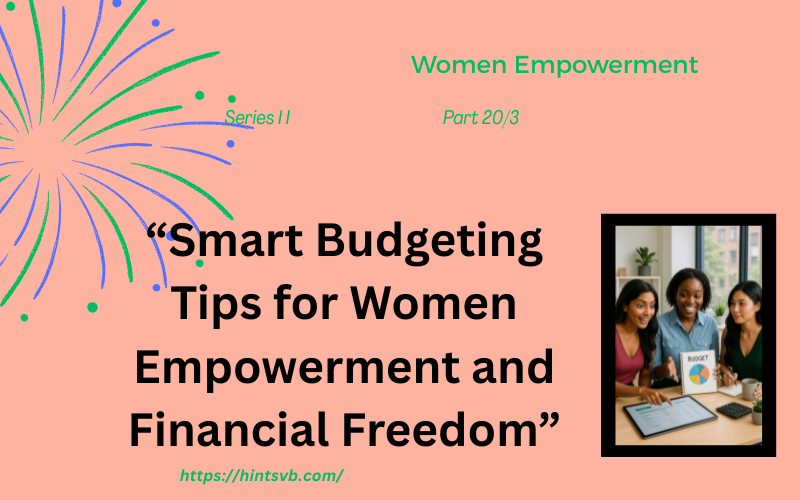
    Women Empowerment Series  II      Part 20/3

    “Smart Budgeting Tips for Women Empowerment and Financial Freedom”

    Introduction: Why Budgeting is a Feminist Act

    For centuries, women’s financial choices were restricted by societal systems, fathers, or husbands. Owning money—or even a bank account—was once a privilege, not a right. Today, when a woman creates her own financial plan, she is making a quiet yet powerful declaration of independence. That act alone is a step toward women empowerment, because financial freedom is inseparable from personal freedom.

    women empowerment

    A budget isn’t just numbers on a spreadsheet; it’s a personal manifesto. It’s a tool that declares: I decide where my money goes. I decide my future. In this sense, budgeting is a revolutionary act. True women empowerment begins with financial self-reliance, and building a well-structured budget is the foundation of that independence.

    Too often, budgeting is portrayed as restrictive—“don’t buy lattes, cut shopping, stop enjoying life.” But the reality is very different. Budgeting isn’t about saying no; it’s about choosing where to say yes. It’s about aligning money with values instead of fear, guilt, or impulse.

    This guide reframes budgeting as a feminist practice—an act of reclaiming power. Mastering your money is the first step toward lasting women empowerment, absolute financial security, and long-term independence. Whether you’re paying off student loans, saving for a home, building a safety net, or planning retirement, this roadmap offers actionable, psychologically aware strategies to design a budget that works for your unique life.

    The Stark Reality: Why Women Need a Different Approach to Budgeting

    It’s Not You, It’s the System: Understanding the Financial Gender Gap

    women empowerment

    When women struggle financially, it’s not due to a lack of discipline or ambition. It’s often the result of systemic inequities that make budgeting both more challenging—and more essential.

    • The Pay Gap: According to U.S. labour data, women still earn just 82 cents for every dollar men earn. That smaller pay check means less room for error and a greater need for precise budgeting.
    • The Caregiver Penalty: Women are more likely to take career breaks for childcare or eldercare, which reduces lifetime earnings and retirement savings.
    • The Longevity Risk: Women live an average of five years longer than men, requiring a larger retirement nest egg.
    • The Confidence Gap: Studies show women often feel less confident about investing, despite evidence that female investors frequently outperform men due to consistent, long-term strategies.

    This financial landscape isn’t fair, which is why strategic budgeting is non-negotiable for women empowerment. A smart budget doesn’t just balance numbers—it levels the playing field.

    Mindset Shift: From Restriction to Liberation

    Your Budget is a Tool for Choices, Not Chains

    If the word “budget” makes you think of deprivation, it’s time for a reframe. A budget isn’t about punishment—it’s about possibility.

    women empowerment

    Think of it as a “values allocation plan”: a system that ensures your money goes to what matters most to you. That could mean travel, education, homeownership, or building a business.

    The psychology is powerful here: when you consciously direct money, your brain moves from scarcity to abundance. You stop obsessing over what you can’t have and start celebrating what you’re choosing.

    Exercise: Ask yourself—What does finance & independence look like to me? Write it down. Is it a paid-off home? Quitting a toxic job? Retiring at 55? Whatever the vision, your budget is the step-by-step map to get there.

    The Foundation: Building Your Empowering Budget

    Step 1: Know Your Numbers – The Financial Self-Audit

    Before you can create a strong and empowering budget, you need clarity. That begins with knowing exactly what’s coming in and what’s going out. Start with a financial self-audit. Use tools like Mint, YNAB, or a simple spreadsheet—or even just pen and paper if that’s your style. Track:

    • Income: Salary, freelance work, side hustles, or passive income streams.
    • Expenses: Break them into categories. Essentials like rent, bills, and groceries. Non-essentials like dining out, subscriptions, or impulse shopping. And finally, dream expenses—those future goals such as travel, hobbies, or personal growth investments.

    Categorize each line into Needs, Wants, and Dreams so you clearly see where your money is flowing.

    Step 2: Choose Your Budgeting Method

    Once you know your numbers, choose a method that resonates with you:

    • 50/30/20 Rule: 50% to needs, 30% to wants, 20% to savings or debt payoff.
    • Zero-Based Budgeting: Every single dollar is assigned a job.
    • Values-Based Budget: Align your spending with your personal values and goals—perfect for women empowerment and financial independence.
    • The Anti-Budget: Save a fixed percentage upfront, then spend the rest freely without guilt.

    There’s no single “right” way—only the approach that keeps you consistent and helps you stay in control.

    Budgeting for the Realities of Women’s Lives

    When creating a budget, it’s important to go beyond just rent, bills, and groceries. Women often juggle unique financial responsibilities, and acknowledging them upfront builds both resilience and confidence.

    Pay Yourself First Fund: Set aside money for emergency savings—ideally 3 to 6 months of expenses—as well as retirement contributions of 15–20% of income. These accounts protect your present and secure your future.

    Caregiving Category: Many women take on caregiving roles, whether for children, parents, or even themselves. Budgeting for future childcare, eldercare, or health-related costs ensures you’re prepared.

    Irregular but Inevitable Fund: Life throws curveballs like car repairs, medical co-pays, or annual holiday expenses. Having a category for these avoids stress when they appear.

    F-U Fund: This is your freedom fund—the money that allows you to walk away from toxic workplaces or unsafe environments.

    Investments: Even small, consistent contributions to index funds, ETFs, or employer-sponsored retirement plans help build long-term wealth.

    This kind of budgeting honours women’s unique financial journeys and empowers lasting independence.

    Here’s the expanded version (around 150 words):

    Advanced Budgeting Strategies for Growth

    From Surviving to Thriving: Using Your Budget to Build Wealth

    Once the basics are in place, it’s time to use your budget as a tool for growth rather than just survival. A strong budget doesn’t just cover bills—it actively builds wealth and independence.

    Side Hustle Strategy: Any additional income should be treated with intention. A proven split is 50% toward debt repayment, 25% into savings or investments, and 25% for guilt-free enjoyment. This ensures balance between responsibility and reward.

    Automate Empowerment: Set up automatic transfers to savings accounts, retirement plans, or investment portfolios. Automation reduces the reliance on willpower, making consistency effortless and building long-term wealth steadily.

    Periodic Reviews: Life is dynamic, and your budget should evolve with it. Reassess quarterly or during major life events like a career shift, relocation, or family changes. Regular adjustments keep your finances aligned with your goals and values.

    Navigating Financial Relationships with Confidence

    Budgeting with a Partner, Without Losing Your Independence

    Money and relationships are deeply connected, yet discussing finances with a partner often feels uncomfortable. Still, open communication is essential for trust and long-term harmony. When building a life together, couples have a few common models to consider.

    Joint Accounts: Ideal for shared expenses like rent, groceries, and bills. This approach fosters transparency and teamwork but requires clear agreements on contributions.

    Separate Accounts: Each partner manages their own money, ensuring independence and autonomy. This can prevent conflicts but still demands coordination for shared goals.

    Hybrid Models: A balanced approach, where both joint and individual accounts exist. This method combines teamwork with financial freedom.

    Regardless of the model chosen, it’s vital to protect your credit, assets, and identity. Maintaining financial independence within a partnership doesn’t weaken love—it strengthens respect, security, and equality. Confidence with money nurtures both personal power and relationship health.

    Tools and Resources to Make It Easy

    Building strong money habits is easier when you have the right tools at your fingertips. Budgeting apps like Mint, YNAB (You Need a Budget), and Pocket Smith help you track spending, set savings goals, and stay accountable. For deeper guidance, books such as Get Good with Money by Tiffany Aliche and The Financial Diet offer practical, relatable advice. You can also learn through podcasts like Brown Ambition, online forums like https://www.mutualfundssahihai.com/en/important-of-women-financial-independenceFinancial Independence, or supportive spaces like local women’s investing clubs.

    Conclusion: Your Budget, Your Future, Your Freedom

    A budget is more than just numbers on a spreadsheet—it is a reflection of your priorities, your values, and the vision you hold for your life. It’s not about restriction; it’s about direction. A well-designed budget creates clarity in the present and lays out a roadmap for the future, helping you align daily decisions with long-term goals.

    For women, budgeting is not only a financial tool but also a powerful act of self-determination. True women empowerment is rooted in the ability to make independent choices, and financial self-reliance is at the core of that freedom. When you create and follow a budget, you are actively taking control of your money rather than letting it control you. This shift brings confidence, security, and the freedom to dream bigger.

    Financial planning allows women to invest in themselves, support their families, and contribute to communities from a place of strength. Whether it’s building savings, paying off debt, or funding a new opportunity, budgeting transforms possibilities into realities. Ultimately, women empowerment grows when women master their money—because when you master your finances, you master your future. And with that mastery comes the ultimate reward: freedom.

    Final CTA:

    • Challenge: Track your spending for three days. Awareness is the first step.
    • Share one budgeting tip that empowered you in the comments below!
    • Bookmark this guide and revisit it each quarter.

    Your budget is not a burden—it’s the practical engine of your freedom.