Tag: DilSePoochein

  • Healing after Rebound-Dil Se Poochein Emotional Wellness (Series I Part 9)
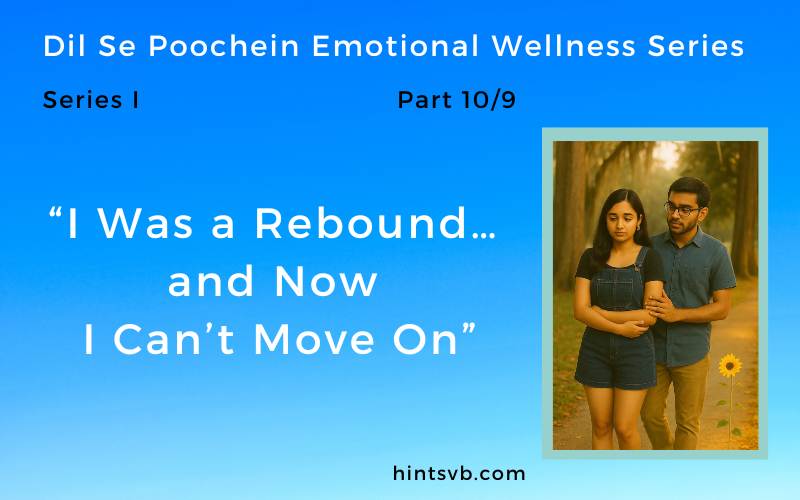
    Healing after Rebound-Dil Se Poochein Emotional Wellness (Series I Part 9)

    I Was a Rebound… and Now I Can’t Move On

    The Moment You Realize It Wasn’t Love

    Rebound relationships often begin like sudden sunlight after a storm.
    You meet someone when your heart is still bandaged from a breakup.
    The attention feels soothing, the smiles effortless, and the emptiness lighter.
    But one day — sometimes suddenly — you realize that what felt like comfort was actually a pause between pain and peace.
    That’s when the real journey of healing after rebound begins.

    Understanding this truth can be painful.Realizing “I was a rebound” hits deeper than a normal breakup — it questions your worth, timing, and judgment all at once.

    healing after rebound

    Yet this moment of realization is also your first step toward clarity.
    Because what feels like rejection is often redirection — a quiet path that leads you back to self-respect and emotional healing after rebound love.

     What Exactly Is a Rebound Relationship?

    A rebound is a relationship that begins too soon after a previous one ends—when at least one person hasn’t healed.

    The new partner becomes a mirror, a distraction, or an emotional band-aid.

    Typical signs include:

    • Communication that revolves around the ex.
    • Over-affection that fades once loneliness eases.
    • Sudden emotional withdrawal after initial intensity.
    • The feeling that you’re being compared, not connected.

    Understanding these patterns prevents self-blame. It wasn’t your failure; it was emotional timing gone wrong.

    Why Rebounds Hurt More

    Rebounds end with confusion, not closure. You never fight—things just fade.
    That silence hurts because it leaves no clear reason to hold or to let go.
    Psychologically, a rebound amplifies loss layered upon loss:
    you lose both the person and the illusion that you had finally healed.

    Your mind keeps replaying the happy beginnings, while your heart keeps asking, “Did I ever really matter?”
    Yes—you did. But your role was to help someone remember what love feels like, not to be their permanent stop. Accepting that truth is freedom.

    The Science of Attachment and Withdrawal

    When you fall in love, your brain releases dopamine and oxytocin—the same chemicals triggered by comfort and safety.
    In a rebound, those chemicals flood faster because the body is craving stability after emotional trauma.
    When the relationship ends, you experience emotional withdrawal, similar to detox.

    That’s why even logic doesn’t help.
    Healing isn’t only mental—it’s biochemical.
    To recover, your daily routine must re-train both body and mind toward calm consistency.

    How to Know You Were a Rebound

    Ask yourself honestly:
    Did the relationship begin immediately after their breakup?
    Did conversations often circle back to their ex or unresolved past?
    Did the emotional intensity fade once their pain started to heal?
    Did talks about commitment suddenly create distance or discomfort?

    If your heart quietly says yes to most of these, it’s likely you entered a space meant for healing, not building. That doesn’t mean your feelings were one-sided — it means you became part of someone’s recovery process. Recognizing this truth is strength, not shame. It helps you step back without bitterness and understand that even temporary connections can hold lasting emotional lessons.

    Healing After a Rebound Relationship

    True healing after a rebound relationship isn’t about forgetting the person — it’s about understanding why you needed them at that time.
    You were seeking comfort, validation, and distraction from pain.
    Now, it’s time to seek peace.

    Healing After Rebound

    Start with acceptance — the connection was real even if it wasn’t meant to last.
    Let that truth settle without guilt.
    Next comes detachment — unfollow if needed, stop checking updates, and resist the urge to decode silence.
    Forgiveness is your emotional detox; it releases energy trapped in resentment.

    Finally, reconstruction — rebuild your days with mindful routines.
    Write, exercise, meditate, or learn something new.
    Each small act of discipline rewires your heart toward balance and becomes a part of your quiet healing after rebound journey.

    Remember, healing after rebound isn’t a single step; it’s a gentle reintroduction to yourself.
    It happens slowly, in the silence between memories and acceptance.
    And one morning, you’ll wake up and realize the ache has softened — not because someone replaced them, but because you finally filled the empty space with your own peace, purpose, and emotional strength.

    When You Can’t Move On

    Sometimes it isn’t the person who keeps you stuck — it’s the emotion left unresolved.
    You replay conversations, imagine alternate endings, or wait for closure that may never come. The truth is, you’re not holding on to them; you’re holding on to what was unfinished inside you.

    To release it, express what remained unsaid. Write a letter you’ll never send, record a voice note only you’ll hear, or talk openly with a counsellor. Each emotion must pass through three sacred stages — expression, understanding, and release.
    If you skip one, it lingers quietly in your subconscious, surfacing again in future bonds.

    Moving on doesn’t mean forgetting; it means remembering without pain — with gratitude, growth, and gentle self-forgiveness.

    Lessons for Gen Z and Modern Love

    This generation connects through screens, but still bleeds in silence.
    Social media makes falling in love easy — and moving on harder.
    Rebounds, ghosting, and emotional burnout have become common because distractions never stop.
    Yet, true healing after rebound requires something digital life often forgets — time, patience, and genuine emotional presence.

    Gen Z’s biggest strength is awareness. They understand mental health, boundaries, and emotional honesty better than any generation before.
    But awareness must turn into practice.
    Healing after rebound begins when you stop masking pain with distractions and start naming your emotions with courage.
    Practice emotional literacy — speak what you feel instead of escaping it through reels or texts.

    Talk about therapy the way you talk about fitness; make self-respect a daily ritual, not a caption.
    Remember, healing after rebound love is not about deleting memories — it’s about transforming them into lessons.
    Vulnerability is not an error in your code; it’s your humanity showing online. That softness, when held with self-worth, becomes your real power and your path toward healing after rebound in the truest sense.

    Turning Pain into Purpose

    Every heartbreak, no matter how unexpected, carries a hidden purpose — to bring you closer to your most authentic self.
    When you finally admit, “I was a rebound, you’re also acknowledging, “I was capable of love even when someone else was healing.”
    That isn’t weakness; it’s emotional depth — the courage to feel fully while others build walls.

    Healing After Rebound

    Use that awareness to create stronger boundaries and to check your own readiness before entering your next relationship.
    Let your past pain become a compass, not a cage.
    Each scar is proof that you risked connection, and that risk shaped your wisdom.
    Someday, you’ll thank this phase for teaching you a maturity no classroom ever could — the quiet strength of knowing when to stay, and when to let go.

    Practical Affirmations for Recovery

    Healing after rebound begins with what you tell yourself every morning.
    Words carry power — they shape the way your heart rebuilds trust and peace.
    Repeat these affirmations daily, slowly, and with belief:

    • “I deserve love that chooses me freely.”
    • “I release what wasn’t meant to stay.”
    • “Healing is not linear, but I’m moving forward.”
    • “My value doesn’t depend on someone’s readiness.”

    Each line gently rewires your subconscious to expect respect, stability, and genuine love.
    Say them when you wake up, before sleeping, or during moments of doubt — they’ll remind you that healing after rebound is not about rushing recovery, but about creating an inner space where self-worth, calm, and confidence can grow again.

    When to Seek Help

    Sometimes, emotional wounds run deeper than silence can heal.
    If sleeplessness, anxiety, or constant overthinking linger for more than a few weeks, it’s time to reach out for support.
    Speaking to a counselor or therapist doesn’t mean you’re weak — it means you care enough to recover.
    Professional help is not drama; it’s maintenance for the mind, just like exercise is for the body.
    Therapy helps you process pain, rebuild confidence, and find tools to move forward with balance.
    Remember, unseen scars deserve attention too — because healing isn’t about forgetting, it’s about finally feeling safe inside your own heart.

    Healing After Rebound

    The HintVaani Reflection

    “Kabhi kabhi zindagi mein jo rishta ruk jata hai,
    wahi aapko aage badhne ki taqat de jata hai.”

    Every ending carries a hidden blessing. Sometimes, the relationship that stops midway becomes the very reason your healing after rebound begins.
    It’s the universe’s quiet way of showing that strength is born not from holding on, but from learning to let go with grace.

    You were never just a rebound; you were a reminder that real emotions still breathe in a distracted world chasing temporary validation.
    Through every tear and every silence, you were walking the first steps of healing after rebound love — learning that depth is not a weakness, but a divine sign of feeling truly alive.

    Carry that grace forward.
    Turn your pain into peace, your silence into wisdom, and your story into strength.
    Because healing after rebound is not just recovery — it’s rebirth.
    And as HintVaani reminds, those who heal the heart always find their higher purpose.

    Conclusion — Let This Be Closure

    Healing after rebound is not about winning or losing — it’s about reclaiming your inner peace.
    When a relationship ends without answers, the mind keeps searching for logic, but the heart seeks closure. The truth is, not every story ends with clarity; some end with lessons that take time to understand.

    When you stop chasing explanations, you begin to rediscover self-respect.
    You realize that closure doesn’t come from another person — it comes from acceptance.
    From understanding that what was real has already served its purpose, and what remains is the wisdom it left behind — the essence of true healing after rebound love.

    Healing begins the moment you choose stillness over chaos.
    It’s when you stop replaying the past and start honoring your own journey.
    You no longer wait for an apology or a message — you create your own peace.

    Every heartbreak, even a rebound, refines your emotional strength.
    Let this phase be your gentle guide toward healing after rebound, not with bitterness, but with gratitude for how far your heart has come — and the calm it has finally found.

  • Silent Regret and Path to Healing – Dil Se Poochein  Emotional Wellness Series I Part 8 of 10

    Silent Regret and Path to Healing – Dil Se Poochein Emotional Wellness Series I Part 8 of 10

    What If They Never Knew I Loved Them? Dil Se Poochein the Silent Regret and Path to Healing

    Introduction

    Have you ever sat quietly at night, staring at the ceiling, asking yourself, “What if they never knew I loved them?” That haunting question creeps into our thoughts, long after the moment has passed. Maybe it was a friend you cherished, a family member you admired, or someone whose smile lingered in your mind for days. But you never said it. You never acted on the feeling. Now, you wonder—did they ever suspect? Did they ever feel it without words? In such moments, it’s important to dil se poochein—ask your heart what it truly needs.

    Is it closure, forgiveness, or simply the courage to love without fear? Listening to your heart can guide you toward healing and help you transform regret into strength.

    Dil Se Poochein

    Unexpressed love is one of the most profound emotional burdens we carry. It shapes how we see ourselves, how we relate to others, and how we navigate relationships. This silent regret can weigh on the heart, clouding judgment, affecting self-worth, and holding us back from emotional wellness.

    In this article, we’ll explore why people hide feelings, the fear of confessing love, and the consequences of hidden love—not just for ourselves but for those we care about. More importantly, we’ll look at how to heal unspoken love, turn regret into strength, and open the door to a fuller, more courageous life. Let’s reflect, together, and ask—dil se poochein—what our heart truly needs to find peace.

    What Happens to People Who Were Never Loved? (The Foundation)

    When love is absent—or unexpressed—it leaves more than a gap in our hearts. It leaves an imprint on our psyche and our relationships. For those who grew up feeling unseen or emotionally distant, love wasn’t something freely given or received. Many adults carry forward the effects of such deprivation, whether they grew up in a strict household where emotions were discouraged or in environments where survival came before affection. In such times, it’s important to dil se poochein—ask your heart what it truly needs to feel safe and connected.

    Psychologists explain that the lack of expressed love can lead to attachment issues. Children who didn’t receive warmth may develop avoidant or anxious attachment styles as adults, struggling to trust others or fearing abandonment. They often wrestle with self-worth, believing they are unlovable or undeserving of care. If you find yourself stuck in these patterns, take a moment to dil se poochein and explore what old wounds need compassion and healing.

    But it’s not only about the person who never received love—it’s about the person who never expressed it, too. When we hold back, our relationships remain surface-level, lacking depth, trust, and intimacy. We deny others the chance to feel cherished and supported. The cost isn’t just emotional—it’s relational, psychological, and spiritual. So pause and dil se poochein whether fear or pride is standing in the way of opening your heart fully.

    Understanding this foundation is critical. Love unspoken can be a double-edged sword: protecting us from pain in the moment, yet depriving both parties of connection. When we recognize this, compassion for ourselves and others begins to bloom. In those quiet moments of reflection, dil se poochein what barriers you’ve built—and how you can gently dismantle them to invite love, trust, and connection into your life.

    Why We Hold Back: The Anatomy of Silence

    Why do we hold back from confessing love, even when it feels so natural? The answer lies deep within our fears, conditioning, and insecurities.

    Fear of Rejection

    Dil Se Poochein

    At its core, fear of confessing love is rooted in primal survival instincts. Vulnerability feels dangerous, and rejection feels like abandonment—not just emotionally but existentially. If someone doesn’t return our affection, we fear that connection itself might dissolve. So we retreat into silence, convincing ourselves that saying nothing is safer.

    The Tyranny of Timing

    We often wait for the perfect moment—when circumstances are ideal, when we feel ready, when life is less complicated. But this tyranny of timing is a trap. Days turn into months, and months into years, while our feelings remain bottled up. The longer we wait, the harder it becomes to express them honestly.

    Insecurities and Self-Doubt

    “I’m not good enough.” “They probably don’t feel the same.” These thoughts create an internal narrative that convinces us that love is a privilege we don’t deserve. Our fear of embarrassment or rejection distorts reality, making love seem impossible rather than probable.

    Cultural and Familial Conditioning

    In many societies, open discussions about love and vulnerability are discouraged. Emotional restraint is praised, and expressions of affection are seen as weakness. Children raised in such environments grow up conditioned to hide their emotions—not because they lack love but because they fear judgment, shame, or ridicule.

    Understanding why people hide feelings helps us release the harsh self-criticism that often accompanies this silence. It’s not a flaw—it’s a human reaction to protect oneself.

    The Cost of Silence: Living with “What If?”

    Silence may seem like a temporary shield, but over time, it becomes a heavy stone sitting on the heart.

    The Burden of Regret

    Living with unexpressed love means living with the constant thought: “What if I had told them?” This question loops endlessly, creating anxiety, sadness, and a sense of loss for something that never fully existed.

    Missed Opportunities

    We construct entire alternate realities in our minds—stories where we confessed love, where the other person reciprocated, and where life took a different path. These imagined worlds are powerful, but they trap us in nostalgia and longing for something that can’t be verified or reclaimed.

    Emotional Stagnation

    When regret is held onto, it blocks the flow of new relationships. We fear opening up again, worried that history will repeat itself. Emotional stagnation develops, preventing us from experiencing connection in the present.

    The Myth of “Love in Silence”

    Many romanticize silent love as noble or pure. While it’s true that unselfish love holds beauty, clinging to silence as a way to avoid pain is often self-sabotaging. Love thrives in communication, not concealment. Without sharing, love stagnates and festers, rather than nourishing both people involved.

    Acknowledging the cost of silence is the first step in healing it.

    What Happens If They Never Knew? The Ripple Effect

    So, what happens if the person we loved never knew?

    On Relationships

    The fear of rejection can morph into a pattern of withholding emotions, making it harder to form authentic connections. We become guarded, avoiding intimacy out of self-protection.

    On Inner Peace

    The lack of closure festers. We may carry sadness or anxiety for years without knowing why. This quiet unrest is emotionally exhausting, keeping us disconnected from ourselves.

    On Life Narrative

    The story of unexpressed love becomes a defining chapter in our lives. We may repeatedly frame ourselves as unlucky or flawed, embedding the regret into our identity rather than allowing it to be a passing experience.

    Yet, asking this question gently—“What if they never knew?”—can also guide us toward awareness. It invites us to face our feelings rather than bury them, creating space for healing and compassion.

    The Signs They Might Have Known Anyway: The Unspoken Language

    Even if we never confessed love, that doesn’t mean the other person never sensed it.

    Body Language

    Subtle, unconscious behaviors often reveal what words do not. A lingering glance, slight changes in posture, or a softened expression when speaking with you are all signals that love was perceived without a word.

    Subtle Signals

    The tone reserved for you, the way someone prioritizes your needs, or the energy shared during interactions can all convey unspoken affection. Human connection thrives on intuition, and love doesn’t need constant verbal validation to be felt.

    The Unspoken Connection

    Have you ever felt understood without explaining yourself? That shared silence, that comfort in each other’s presence—it’s a bond rooted in something deeper than spoken love. It may very well be that they knew, in some form, without words.

    Recognizing these signs brings comfort. Love transcends language and can live quietly in gestures, expressions, and the spaces between conversations.

    How to Heal From the Weight of Unexpressed Love

    Healing unspoken love requires gentleness, courage, and self-compassion.

    Radical Self-Acceptance

    First, acknowledge your feelings without judgment. You did the best you could with the emotional tools you had at the time. Instead of criticizing yourself, offer kindness. Understand that vulnerability is not weakness—it’s bravery in disguise. Take a quiet moment and dil se poochein what you need to feel safe and supported in this process.

    Finding Closure Without Them

    Closure doesn’t always require the other person’s response. Writing an unsent letter, journaling your thoughts, or using visualization techniques can help you process emotions. Talking to a therapist or trusted friend offers another layer of support. As you explore these steps, dil se poochein how you can honor your feelings while freeing yourself from past burdens.

    Understanding the Psychology of One-Sided Love

    Recognize that much of the longing comes from an idealized version of the person. The fantasy we create often outweighs the reality of what might have been. Learning to disentangle the imagined from the real helps in finding peace. When confusion arises, dil se poochein what your heart truly desires and what it needs to heal.

    Moving Forward

    The goal isn’t to erase love but to integrate it. Decide that this chapter will not dictate your future relationships. Commit to being more open, honest, and emotionally available, even when it feels uncomfortable.

    Healing unspoken love is a courageous journey—and every step, however small, brings you closer to emotional wellness. By gently listening to yourself and asking, dil se poochein, you allow healing to begin from within.

    Turning Regret Into Growth: Five Paths Forward

    Regret can either trap us or transform us. Here are five lessons that can guide you:

    1. Lesson in Courage
      The experience teaches you bravery with your emotions. Next time, you may be more willing to share your heart.
    2. Lesson in Self-Discovery
      You learn what truly matters in connection and what values guide your relationships.
    3. Lesson in Presence
      You begin to appreciate and express love for those in your life now, rather than waiting for the perfect moment.
    4. Lesson in Compassion
      You develop empathy—not only for yourself but for others who struggle with vulnerability.
    5. Lesson in Imperfection
      It reminds you that humans are inherently flawed and that love doesn’t need to be perfect to be meaningful.

    As you reflect on these lessons, ask yourself—dil se poochein, what does my heart need to feel peace today? Our unexpressed loves are not burdens to carry but teachers urging us toward growth, courage, and emotional wellness.

    Dil Se Poochein

    Let your regret fuel compassion, connection, and self-understanding. You are not defined by the love you kept hidden—you are defined by the love you choose to express, today and every day forward.

    Conclusion : Final Thoughts

    What if they never knew you loved them? It’s a question that haunts many but need not imprison you. By understanding the psychology behind silence, recognizing the ripple effects of regret, and embracing healing practices, you can turn past wounds into future strength.

    Ask your heart gently—dil se poochein—what it truly needs. Whether that’s forgiveness, closure, or courage, the path forward is available to you. The love you held inside is not lost; it’s waiting to guide you toward a more compassionate, empowered, and emotionally well life.

    Let your story be one of growth, resilience, and the quiet beauty of a heart that dared to love—even if it spoke in silence.